What Is a Thread?

What Is a Thread?
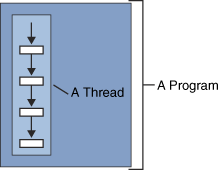
A thread is similar to the sequential programs described previously. A single thread also has a beginning, a sequence, and an end. At any given time during the runtime of the thread, there is a single point of execution. However, a thread itself is not a program; a thread cannot run on its own. Rather, it runs within a program. The following figure shows this relationship.
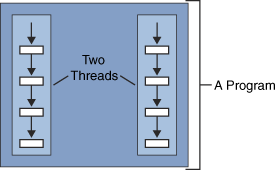
The real excitement surrounding threads is not about a single sequential thread. Rather, it’s about the use of multiple threads running at the same time and performing different tasks in a single program. This use is illustrated in the next figure.
Some texts call a thread a lightweight process. A thread is similar to a real process in that both have a single sequential flow of control. However, a thread is considered lightweight because it runs within the context of a full-blown program and takes advantage of the resources allocated for that program and the program’s environment.
As a sequential flow of control, a thread must carve out some of its own resources within a running program. For example, a thread must have its own execution stack and program counter. The code running within the thread works only within that context. Some other texts use execution context as a synonym for thread.
Thread programming can be tricky, so if you think you might need to implement threads, consider using high-level thread APIs. For example, if your program must perform a task repeatedly, consider using the java.util.Timer class. The
 Timer class is also useful for performing a task after a delay. Examples of its use are in the section Using the Timer and TimerTask Classes .
.
If you’re writing a program with a graphical user interface (GUI), you might want to use the javax.swing.Timer class instead of java.util.Timer. Another utility class, SwingWorker, helps you with another common job: performing a task in a background thread, optionally updating the GUI when the task completes. You can find information about both the Swing Timer class and the SwingWorker class in How to Use Threads.
Basic support for threads in the Java platform is in the class java.lang.Thread. It provides a thread API and provides all the generic behavior for threads. (The actual implementation of concurrent operations is system-specific. For most programming needs, the underlying implementation doesn’t matter.) These behaviors include starting, sleeping, running, yielding, and having a priority.
To implement a thread using the Thread class, you need to provide it with a run method that performs the thread's task. The section Implementing the Runnable Interface tells you how to do this. The next section, The Life Cycle of a Thread, discusses how to create, start, and stop a thread. The section Thread Scheduling describes how the Java platform schedules threads and how you can intervene in the scheduling.


Comments
Post a Comment